

Why China. Part I
In the Beginning was the Law

Dozens of books have been written about how and why the West became the most economically and politically successful civilization in human history. But today, the West no longer looks as successful as it did 20 or 30 years ago. Europe is stuck in stagnation, while the United States is increasingly convulsed by instability. On both sides of the Atlantic, voices are growing louder in claiming that the Western model — liberal democracy — has exhausted itself and no longer meets the challenges of the age.
Europe has seen such moods before. A century ago, Spengler ― and many others ― wrote of its decline. Back then, pessimism proved unfounded: Europe, and the West as a whole, revived and once again reaffirmed its global leadership. But what if that was their swan song? What if those writing the West’s obituary were essentially right, only a little premature?
Such thoughts are becoming more common, and pessimists have little doubt about who will bury the West. It is China, which has already overtaken Europe technologically and is rapidly closing in on the United States.
The West — and Europe before it — has faced many formidable rivals: Persia in antiquity, the Arabs after the fall of the Roman Empire, the Ottomans in the Middle Ages, the Soviet Union in the twentieth century. By historical standards, all of them lasted only briefly — a century or two, five at most. But China has remained such a rival for two and a half millennia. Unlike the Persians, Arabs, or Turks, Europe did not come into direct confrontation with China until the mid-nineteenth century, during one of China’s periods of weakness. Yet at its end of the Eurasian continent, China was almost always a power no less significant — and often greater — than the European states at theirs.
If the West can be called the world’s most successful civilization, then China has held a firm second place for millennia. And at this moment, it is actively competing for first. Despite the popular saying that second is the first loser, holding second place for so many centuries is an extraordinary achievement. Understanding what made a challenger capable of challenging you is hardly a pointless exercise.
Yet unlike the countless analyses of Europe’s success, books explaining what made China the world’s second most successful civilization are surprisingly hard to find — at least in the West.
There is no shortage, however, of books about why China lost the political and economic race to the West in the nineteenth century. Nor is there any shortage of books explaining its current success, beginning their analysis in the 1970s. But history did not end in the nineteenth century, and the roots of China’s present achievements do not begin in the 1970s; they run centuries, even millennia, deeper.
Why is China such a resilient civilization? Why does it rise from the ashes again and again? Why has it become the West’s principal challenger?
Why China?
Pondering this fascinating question I read nearly two dozen books and an uncountable number of articles on China, and listened to hours of interviews with specialists in its history, economy, and political system. What follows is my attempt at an answer.
That answer will inevitably be simplified: to capture all the nuances would require a book series, not a series of articles. But I hope it will still be sufficiently deep and balanced.
1. The End of History
May 1989 was the best month of the twentieth century — the brightest, and the most full of hope.
It began symbolically: on May 1, the authorities of still-socialist Hungary began dismantling the barbed wire on the border with capitalist Austria. And then events gathered momentum. On May 11, the withdrawal of Soviet troops from East Germany began. On May 17, Poland’s still-communist authorities returned to the Roman Catholic Church property that had been confiscated in the 1950s. And on May 21, Moscow’s Luzhniki Stadium hosted the first legal mass opposition rally, where Andrei Sakharov, until recently banished from Moscow, addressed the cheering crowd.
But the high point of hope for freedom — not only of that May, but of the entire century — came on the 24th.
In the Soviet Union, representatives of the factions of the First Congress of People’s Deputies of the USSR, including Sakharov, gathered that day for a preliminary session. A substantial number of them had been elected through free voting for the first time in Soviet history. It became clear that this Congress — on which millions of people, not only in the USSR but around the world, had pinned enormous hopes — would in fact take place. Until the very last moment, many had not been sure. That same day, Soviet television for the first time broadcast the final of the European Cup.
In Beijing, on May 24, 1989, government troops ordered to disperse the protest camp in Tiananmen Square stopped before the barricades erected by the demonstrators, unwilling to fire on the people. A few hours later, the government ordered the troops back to their barracks and promised the students an end to media censorship.
A little more, and that day might have been declared World Democracy Victory Day.
Several weeks or maybe days earlier, when the first free elections had already taken place in the USSR and the Tiananmen protests were already underway — both events are mentioned in the text — the philosopher Francis Fukuyama wrote his now-infamously famous essay The End of History? and sent it to The National Interest.
The question mark in the title was a mark of politeness. Fukuyama was not asking — he was asserting. He argued that liberal ideology had defeated all its rivals and, for the first time in history, stood without competitors — perhaps not forever, but for a very, very long time.
The journal was published quarterly, and the essay appeared in the summer issue, by which time it had already become clear that the end of history would have to be postponed.
The world only fully realized that the liberal model had failed to take root in Russia more than two decades later, when Vladimir Putin sought a third term, though from within the country it could have been understood much earlier, already in the 1990s: there were plenty of warning signs. China delivered its cold shower much sooner. On June 2, Deng Xiaoping ordered that the protesters be cleared from the square — if possible without using the army, but by any means necessary if required.
The next day, shortly after noon, police tried to disperse the students with tear gas, but the students drove them back with stones. That evening, the government called on Beijing residents by radio to stay off the streets, and troops began advancing toward the barricades erected on the approaches to the square. Stones and Molotov cocktails again flew at the soldiers. This time, they opened fire.
Casualties mounted on both sides, but the balance of forces was unequal. At half past one in the morning, troops entered the square. The students, realizing their cause was lost, began to withdraw. By 9 a.m., the square had been cleared.
The famous photograph of the man blocking a column of tanks was taken the next day, on June 5, when the tanks were returning to base across the empty square. The man stood in their path for several minutes, then briefly spoke with the crew of the lead tank and walked away. Neither journalists nor the Chinese security services ever succeeded in establishing his identity.
On the night of June 3–4, according to various estimates, between two hundred and three thousand students were killed, along with about twenty soldiers and riot police officers. Most of them died not on the square itself, but in the streets next to it.
That same day, June 4, Deng Xiaoping — who no longer formally held the highest state or party offices but continued to rule China — decided to remove CPC General Secretary Zhao Ziyang, who had supported the students and advocated political liberalization. His dismissal was officially announced twenty days later, on June 24. Zhao Ziyang spent the rest of his life under house arrest. The political reform he had proclaimed in October 1987 — one that envisioned separating the party from the state — was decisively buried.
Economic reforms also slowed sharply after Tiananmen. The conservative wing of the Politburo even tried to reverse them altogether. But after three years of political struggle, and following a propaganda tour of southern China by the formally retired Deng Xiaoping, they resumed with renewed force — and in some ways even more radically than before.
Thanks to these reforms, the Chinese economy grew at an unprecedented pace for four decades. By the late 2010s, China had drawn close to the United States in economic power and, by some measures, had even surpassed it. Earlier still, people had begun calling the twenty-first century “the Chinese century” in advance. For the first time since the end of the Cold War, the United States had a genuine rival.
Liberal democracy had celebrated victory too early: history, scarcely having reached its supposed end, started its engine again.
And why should it ever have ended?
There has never been a time in world history when one ideology or political system completely triumphed over all others on a global scale. Even if one believes in continuous social progress, it is impossible not to notice that such progress regularly reverses itself — if only for a time. And if we do believe that progress is continuous, then history, by definition, cannot end.
To believe that we happen to live in the one moment when this would occur for the first time — that we have invented the most perfect system possible, one that can no longer be improved — would be an act of unforgivable hubris.
One may, like the ancients, believe that history moves in circles. One may, following the thinkers of the Enlightenment, believe that it moves forward. Both views have their own internal logic.
The end of history has none — unless that end is the end of humanity itself.
2. A New Threat
America’s new rival looks far more dangerous than the old one — at least from today’s vantage point.
The Soviet Union had certain advantages over China. China stands alone: it has neither allies nor satellites. The USSR had both — unwilling satellites in Eastern Europe, which would gladly have escaped its yoke but could not, and genuine independent communist allies in Vietnam, Cuba, and other countries across Asia, Latin America, and Africa.
The USSR had an ideology that attracted hundreds of millions of people around the world. It had a sincere fifth column in the West — people who did not turn down Soviet money, but who were also willing to advance Soviet interests out of genuine conviction. China has none of this. It has failed to build its own geopolitical bloc; “socialism with Chinese characteristics” is merely a pretty label for capitalism without democracy; and China’s fifth column in the West, though it undoubtedly exists, works only for cash.
But China has something the Soviet Union never had: a well-functioning market economy and the ability to compete with the West in technology in real terms.
In virtually everything except nuclear energy and space — that is, atomic warheads and ballistic missiles — the USSR lagged decades behind the United States, Japan, and Germany. China is unlikely to lag more than ten or fifteen years in any field, and it is rapidly closing that gap; in some areas, it has already pulled ahead.
And, most importantly, China possesses something the USSR never had even remotely: it is so deeply integrated into Western supply chains that if it decided to shut off the export tap, much of Western manufacturing — including military production — would simply grind to a halt.
At the same time, China itself is approaching self-sufficiency. It already produces most of what its industry needs and is working aggressively to produce everything, achieving full technological autonomy. Trump, at the start of his second term, set the same goal for the United States — but Xi had declared it a decade earlier and has advanced much further.
For the first time in many decades, the competition between two political systems has become genuinely interesting.
But are these systems really so different from one another?
Let us try to look at them with the detached, unbiased gaze of an alien from outer space. Or a time traveler. Or a Buddhist monk. As the title of Shunryu Suzuki’s popular book says, Zen Mind, Beginner’s Mind.
Let us try to look at the United States and China as if we knew nothing about them.
But first, we should define exactly which systems we are talking about.
3. The Third Way
There have been three economic systems in history: capitalism, communism, and the so-called “third way,” which has another name: fascism.
We usually think that communism came after capitalism, but in fact the reverse is true.
The first economic system known to historians was precisely communism.
Not communism as it appears in books — from each according to his ability, to each according to his needs — but real ruthless communism.
The earliest written sources from ancient Sumer and ancient Egypt depict societies in which private property effectively did not exist, apart from household plots and small artisan workshops. The principal product — grain — belonged to the authorities. They took the lion’s share of the harvest from the peasants and then distributed it among their subjects.
True private property began to emerge later, with the invasions of Mesopotamia by nomadic Hittites, Akkadians, and especially Amorites. With them began what we know as the “third way” (though in reality it surely began earlier): an economy based on private property, but with extensive state involvement — the state deciding who should do what and how, redistributing resources (above all land), and mobilizing vast masses of subjects for military and construction projects.
The first capitalist states, where government played only a minimal role in the economy, were probably the ancient Greek city-states. But even there the system was mixed: temples, aqueducts, and other major projects were financed through public funds or semi-compulsory donations.
A similar system existed in the Dutch Republic.
True capitalism — where the state played almost no role in the economy — first appeared in England in the early eighteenth century, and in the United States a century later.
It was extraordinarily successful, giving us the Industrial Revolution and an unprecedented rise in living standards. But in the early twentieth century, it was devoured by the political system.
Today, it no longer exists.
Almost every economic system in the modern world — with the exception of communist Cuba and North Korea — is some version of that same “third way,” where private property and markets exist, but the state plays an active role in the economy.
And in Western countries with so-called “welfare states,” government is more deeply involved in the economy than in most countries of the world.
It is commonly assumed that there is more capitalism in the United States or Germany than somewhere in Africa or Asia, and that this is why they are so successful.
No: if by capitalism we mean the share of the private sector in the economy, there is actually less of it in the West.
Europe and the U.S. are successful because, unlike most of the world, they have the rule of law.
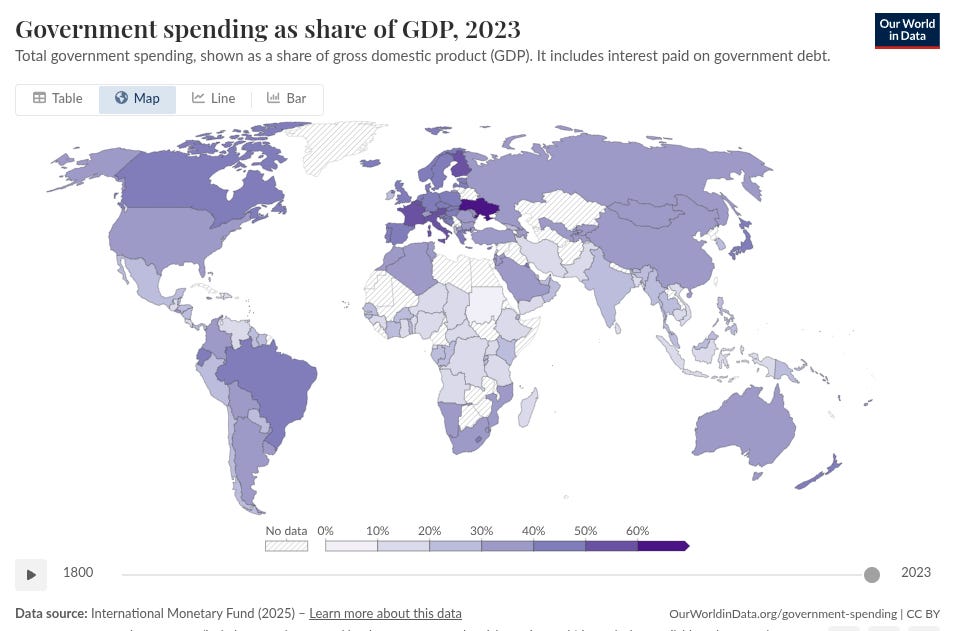
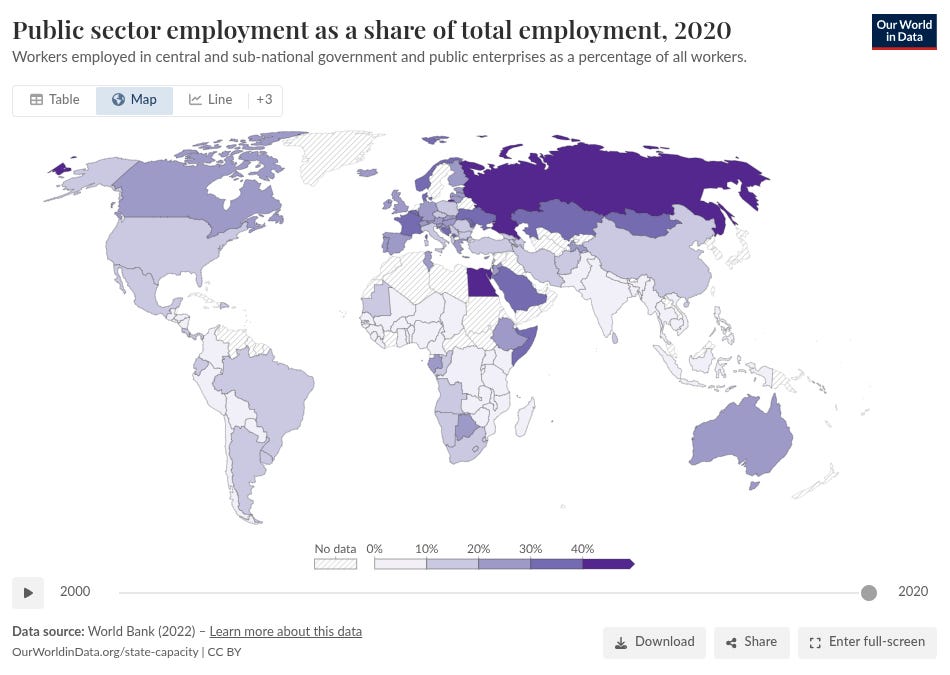
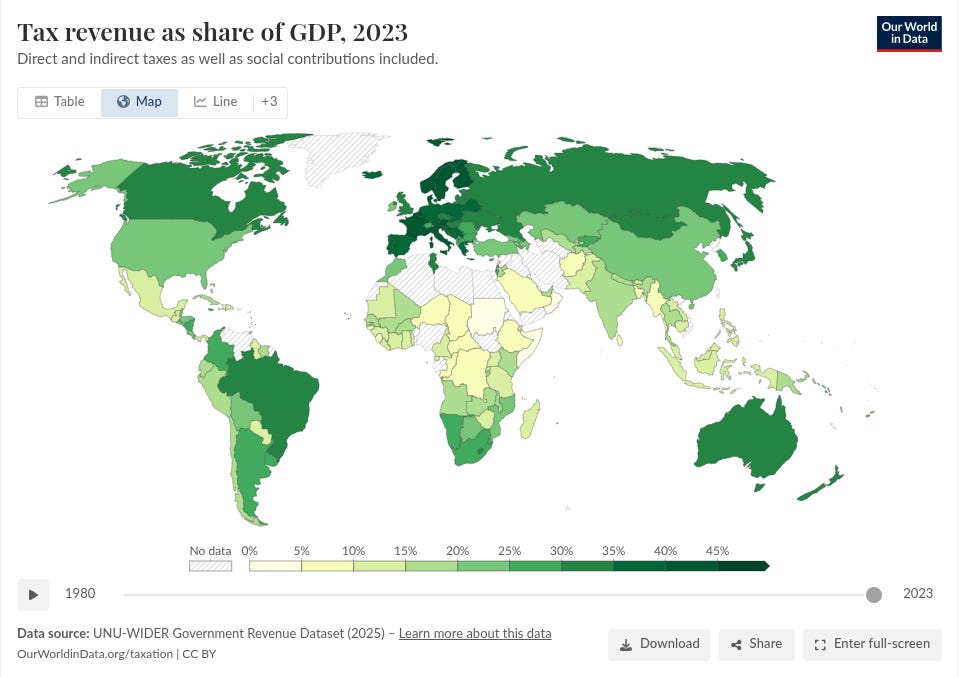
When there was more capitalism in Western countries, they were even more successful — but those days are long gone.
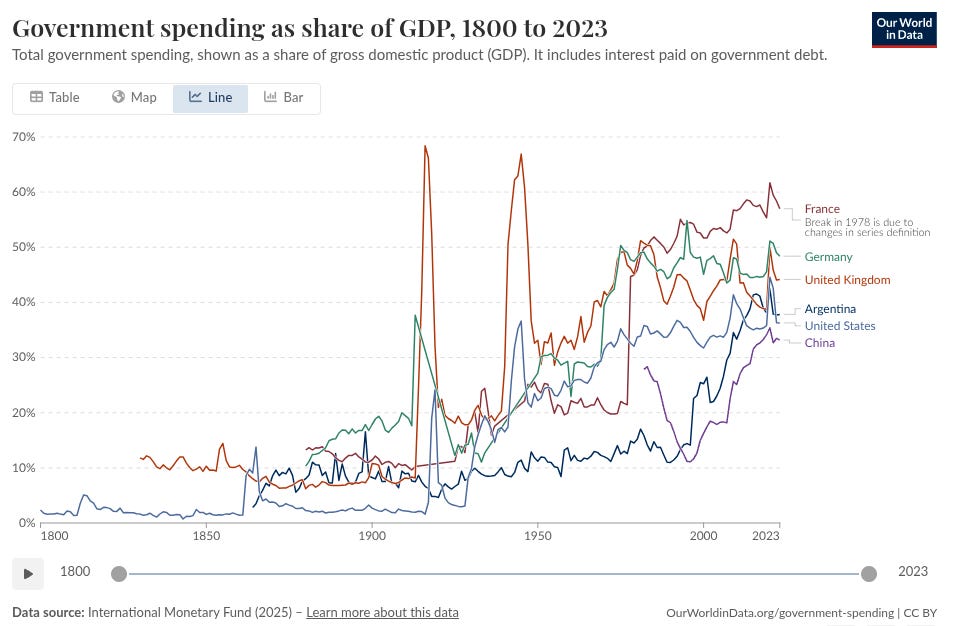
By the first classification, both the United States and China are “third way” systems: private property and market economies combined with extensive state involvement. In the United States, that involvement may even be greater. According to IMF data, government spending there amounts to 37.2% of GDP, whereas in China it is “only” 32.95%. Taxes in the United States account for 24.8% of GDP, compared to 22.1% in China.
But by other measures, China has less capitalism: private business generates only 60% of GDP there — a very large share of the economy is made up of state-owned enterprises — whereas in the United States the figure is 87%.
The second distinction is political.
The ancient Greeks divided political systems into three categories: democracy, where power belonged to the whole people; oligarchy, where it belonged to a minority; and monarchy or tyranny, where it was concentrated in the hands of one person.
What the Greeks called “democracy” bore little resemblance to what we call democracy today. In democratic city-states, every citizen had the right to vote on every issue, and there was, in principle, no supreme authority at all.
Modern Western systems would have been called “oligarchies” by the ancients — or, in republics with strong presidential power such as the United States, mixed systems combining elements of oligarchy and monarchy. I have written about this in more detail here and here.
China, by this classification, is a typical tyranny, though as recently as ten years ago it was more of an oligarchy.
They are also similar in one more respect: social mobility.
In both the United States and China, any individual can, entirely legally and without resorting to violence, rise to become head of state. In the United States, this requires winning a presidential election; in China, joining the Communist Party and climbing to the top of its hierarchy.
But in both systems, the path is formally open: anyone can rise to the top if they play by the rules, rather than only members of one or several noble families, as in the Middle Ages — though in both countries the representatives of the “aristocracy,” meaning the children of fathers who already held high office, naturally have an easier time of it.
All in all, from the standpoint of an impartial observer, the two countries look rather similar, both economically and politically.
Similar — but not identical.
There are two principal differences.
The first is the existence of the rule of law in the narrow sense of the term.
Not so much rights in themselves — freedom of speech, for example, or freedom of assembly — as whether citizens are actually able to defend their property and their liberty in court if the state decides to take them away.
The second is what new institutional economics calls an “open access order,” in which people are free to create organizations to defend their interests without having to seek permission from the state.
China has neither.
The United States has both.
Which of these two systems is more successful?
To answer that question, we first need to understand what exactly “successful” means.
4. Success
In the West, it is commonly assumed that a successful system is one that can provide its population with a good life.
What exactly constitutes a “good life” is understood differently by different people — some on the left consider Cuba an ideal state — but that is not even the main issue. The real question is how good this criterion is in the first place.
The Chinese in the early twelfth century probably lived better than anyone else in the world. But that did not save them from the Mongol invasion, which by modern estimates killed around forty million Chinese.
Some were simply slaughtered — the Mongols, as in other regions, wiped out the populations of entire cities. Others died of famine and epidemics. And that does not even include those who were raped, mutilated, or robbed.
Presumably, many of those victims would have preferred to live in a state that taxed and exploited them more heavily but protected them better.
Another popular criterion of success is the ability to extend one’s control over as much territory as possible.
By that standard, the most successful state was the Mongol Empire of Genghis Khan.
But can a state that lasted only half a century really be called successful, collapsing after the death of his grandson Möngke into four khanates, each of which also survived only briefly — a mere hundred to hundred and fifty years, nothing by historical standards?
Perhaps a successful state is simply one that exists longer than others?
That too seems doubtful.
Many species of tortoise live twice as long as humans, but can one therefore say that tortoises are more successful than people?
And even among states…
Do you know which state has existed continuously longer than any other in the world?
No — it is not China. China does not even make the top ten: the existence of the Chinese state has been interrupted many times.
It is the Kingdom of Denmark.
It has existed continuously — without bloody regime changes through wars or revolutions — for more than a thousand years, since 965. Even during the German occupation in the Second World War, relatively little changed there. In 1943, Denmark even held free parliamentary elections, in which the Social Democrats won, while the local National Socialists received only 2.1% of the vote.
In 965, Danish kings naturally wielded more power than they do today, but even then royal authority was not absolute, and Denmark’s political evolution did not unfold as a series of revolutions, but as a gradual and relatively peaceful process.
Denmark is a wonderful country — if one overlooks the prices, taxes, and climate — but can it really be called the most successful country on Earth?
Hardly.
Perhaps we should turn to evolutionary theory instead.
Evolution considers successful those organisms that are better than others at passing on their genes.
What might that mean in the case of a state? Different things.
For example, long-term cultural influence.
By that criterion, the most successful states on Earth would be ancient Rome and Athens.
Rome was a vast empire; Athens, a tiny city-state. Yet Roman legal theory and ancient Greek philosophy remain, more than two thousand years later, cornerstones of modern civilization — and not only Western civilization.
Close behind come Judea, Arabia, and India, which profoundly shaped the world through the religions born there. Today that influence is less powerful than it once was, but a few hundred years ago it rivaled — and in some respects surpassed — that of Rome and Athens.
Immediately behind them one might place Venice, the Netherlands, and England. Compared to the previous six, they are relatively young, and it may still be too early to judge their long-term influence. But they gave birth to modern capitalism, the modern model of democracy, and the scientific and technological revolution.
Rounding out the top ten is China, which inspired the modern bureaucratic state.
Another example would be direct reproduction — when one state gives rise to other states like itself through the colonization of new lands. By that measure, the most successful states in history were England and Spain.
But unfortunately, this criterion does not help us either.
We will never know whether the United States will one day give England grandchildren by founding colonial states on Mars, Ganymede, or Titan, or whether modern American or Chinese cultures will still shape the world two thousand years from now as Greek and Roman cultures do today — unless, of course, we discover a way to live forever.
In our own lifetimes, however, we may well get to see which of these two countries proves more successful at exporting its political system.
The problem is that neither the Western nor the Chinese system can really be exported to the developing world.
The institutions of both systems took centuries to evolve, shaping the cultures of their respective regions. Without that cultural foundation, copies of Western institutions in the developing world simply do not work.
The European parliamentary system could never have emerged without European feudalism, in which the king was not an almighty tyrant as in most other medieval societies, but first among equals, his relationship with counts and barons defined by contractual obligations.
It is no coincidence that, until the 1990s, the only non-European country that successfully copied parliamentary democracy and rose to Europe’s level was Japan — the only non-European country whose medieval system resembled European feudalism.
From the mid-twentieth century onward, dozens of countries in Asia and Africa began copying European institutions. At best, they became distorted imitations of Europe: poor and corrupt. At worst, they remained medieval despotisms under a new mask.
Because these copies have been mimicry — attempts to resemble the strong, so that the strong will leave you alone.
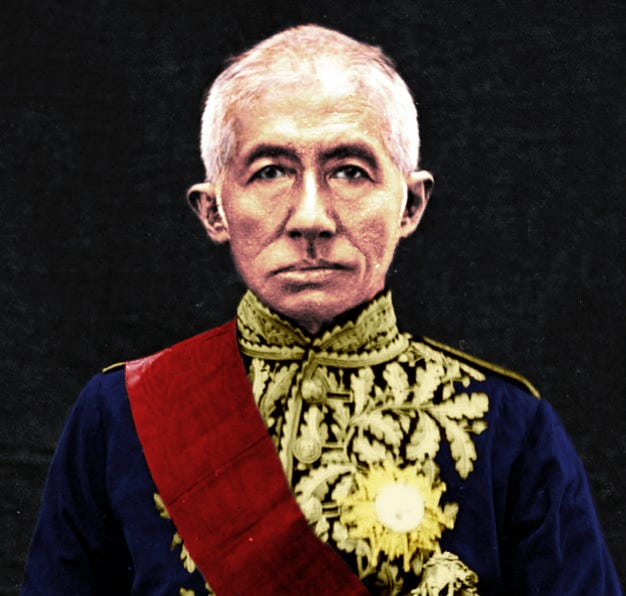
There is a story about Siam — present-day Thailand — whose King Rama IV, in the nineteenth century, watched Britain and France seize the lands of his neighbors and decided that perhaps they might spare Siam if he could prove that it was a civilized country.
He dressed in European clothing and compelled his courtiers to do the same.
He laid Bangkok’s first paved roads, created parks, ordered the construction of European-style buildings, including a new royal palace, opened European-style schools, and even successfully predicted the exact timing of a solar eclipse and the best location from which to observe it (In his youth, he had studied both astrology and astronomy) and took European diplomat on a watching tour.
And… it worked.
Thailand remained the only country in South and Southeast Asia untouched by European colonization.
The semi-official explanation is that Thailand happened to lie between the French and British spheres of influence, and neither France nor Britain wanted border conflicts with the other.
But in Africa — and later in the Middle East — there were plenty of places where British and French colonies shared borders, and that did not seem to trouble them that much.
So “civilized” appearances may well have been the decisive factor.
Soon, we may see countries in the developing world begin adopting the Chinese system as well.
But that, too, would be the same kind of mimicry. Because for that system to function, a country would need centuries of immersion in Chinese political culture — the way this historically happened in Vietnam and Korea.
5. Compatibility
In reality, rather than merely in appearance, only two countries besides Japan have so far managed to successfully copy European political institutions: Taiwan and South Korea.
Both are former Japanese colonies where Japan introduced modern Western-type civil administration and the rule of law. Both are also countries of the Chinese cultural sphere. Taiwan was settled by Chinese immigrants and was part of the Qing Empire for two centuries, while Korea adopted Chinese social institutions hundreds of years ago.
But Korea was not the only country to adopt Chinese institutions.
China’s political system — or rather, an idealized version of it, known in Europe primarily through the accounts of Jesuit missionaries who had lived in China — was actively imitated in Europe as well.
In the eighteenth century, Prussia carried out an administrative reform whose authors, the cameralists, openly acknowledged that their admiration for the Chinese imperial order.
One of them was the great mathematician and philosopher Gottfried Leibniz.
The features they admired included the monarch’s almost unlimited power, active state intervention in all spheres of economic and social life, a professional cabinet of ministers, and a unified mandatory examination for entry into government service — though naturally, candidates were not tested on the writings of Confucius.
France, too, carried out its own civil service reform inspired by China after the French Revolution. One of the chief advocates of the Chinese system there had been Voltaire, who did not live long enough to see the triumph of his ideas in his own country.
For that matter, he recommended Chinese institutions not only to his compatriots but to the very same Prussian king, and to any monarch willing to listen.
Eventually, even England introduced examinations for public office modeled on the Chinese example.
The Northcote–Trevelyan Report, which called for such a reform, was published just two years before the Second Opium War, in which Britain and France not only crushed China but captured Beijing itself. The reform was implemented after that victory.
Following France’s example, Spain and Belgium introduced similar reforms. Following Germany’s lead, Austria and Russia did the same.
By the end of the nineteenth century, China itself was in deep decline, and European powers could do more or less as they pleased there. Yet back home, their own bureaucracies were trying to function according to a Chinese model.
France did not really much from its new system; it may even have been harmed by it, probably coincidentally, but its introduction was soon followed by the state’s geopolitical decline.
But the unified mandatory examination for entry into government service, introduced on the Chinese model, has survived there to this day — unlike in most other European countries.
England did not fare much better than France: the new system was introduced in 1870, and almost immediately afterward Britain gradually began losing ground to Germany and the United States.
Prussia, however, benefited enormously from the reform. It quickly became one of the strongest countries in Europe and succeeded in unifying all of Germany under its leadership.
Prussian — and later German — bureaucracy, along with Prussian and then German Ordnung, were regarded as exemplary up to the beginning of this century.
Perhaps this was because reforms in Prussia began earlier and were implemented far more consistently and thoroughly than in France or England.
Or it was because, unlike those two countries, Prussia did not try to combine the incompatible: concentrated hierarchic authority and parliament: Prussian kings had managed to rid themselves of parliament long before civil service reform began.

When the Qing Empire, after a series of humiliating military defeats, finally decided to try copying European institutions, it chose Germany as its model. There, the reform came to nothing.
In the late 1970s, China once again began copying Western institutions — but this time in economics rather than politics.
American leaders strongly hoped that political reform was only a matter of time, and that sooner or later China would evolve into a liberal democracy.
Nothing of the sort happened.
Instead, Americans themselves began, little by little, copying China, trying to ban TikTok and restrict imports.
One may debate the wisdom or usefulness of such measures, but it is hard to deny that these attempts amount to a sincere admission that their authors believe the Chinese system to be effective.
Could it really be more effective than the Western one?
As far as economic systems are concerned, the picture is clear.
Pure capitalism has not existed anywhere in the world for more than a century, and of the two remaining alternatives, partial capitalism — however one looks at it — has always been more successful than full socialism.
There are simply no historical examples to the contrary.
But both the United States and China are, in essence, predominantly capitalist states.
And although there are substantial differences between their economic systems — which we will discuss later — they have more in common than not.
Political systems are not so simple.
True democracy has not existed anywhere in the world for even longer than pure capitalism — it disappeared before the beginning of the Common Era.
And each of the two remaining systems, oligarchy (which we habitually call “liberal democracy”) and despotism, has its own strengths and weaknesses.
The main problem of oligarchies is slowness.
Power in such systems is always shared among several influential groups, and therefore any important decision requires long and complicated negotiations to reconcile their interests — a process that can take months, sometimes years.
On the other hand, the likelihood of rash, poorly considered actions in oligarchies is very low.
Oligarchies rarely make truly catastrophic mistakes.
But when they do, correcting them also takes years, because that too requires agreement among all the influential groups.
In tyrannies, it’s the reverse.
They surpass other systems in the ability to make immediate decisions.
When one man commands everything and is under no obligation to consider anyone else’s interests, he can act quickly and decisively.
Those decisive actions are often poorly thought out and sometimes disastrous, because there is no one who can stop the despot. But he can also correct mistakes quickly.
Despotism, however, suffers from two additional serious problems.
The first is the selection of government ministers and advisors.
Dictators tend to trust no one, and therefore elevate not the most capable people, but those they trust most: relatives, childhood friends, and skillful flatterers.
The second, closely related problem is feedback.
No one wants to anger the dictator, and so the information presented to him is usually heavily embellished.
China is perhaps the only despotic state in known history where these two problems were addressed with some success as early as a thousand years ago.
6. Europe before Europe
Earlier, I wrote that Japan was the only non-European medieval country with something resembling European feudalism.
That is true as far as medieval societies are concerned.
But there was one other country in world history whose system bore a striking resemblance to European feudalism.
The difference is that its feudal order emerged two thousand years earlier than Europe’s — and disappeared before Alexander the Great was even born.
The first Chinese ruling dynasty whose existence historians regard as certain was the Shang dynasty, which ruled in the second half of the second millennium BC.
We know relatively little about it.
We know, for example, that its rulers also served as high priests and practiced divination on oracle bones; that its craftsmen produced enormous ritual bronze vessels weighing hundreds of kilograms; and that, if ancient chronicles and legends are to be believed, Shang was an empire founded by warrior-merchants — not on the sea, as such states more often were in history, but deep in the interior of the continent.
The Chinese word for “merchant” still literally means “man of Shang,” while the word for “commerce” means “the occupation of Shang.”
Their empire, it seems, was not a true empire directly controlling vast territories, as the later empires of Europe, Western Asia, and China did.
Rather, it was a central kingdom surrounded by several subdued but not occupied semi-independent vassal kingdoms — much like the empires of India.
In 1046 BC (though other dates are sometimes given), one of these vassal kingdoms, Zhou, rebelled and, in the Battle of Muye — which involved more than one hundred thousand men — defeated the Shang army and founded its own dynasty.
In order to provide an ideological justification for their rebellion against the Shang dynasty — which, after all, had ruled for five centuries and had become a kind of spiritual foundation — the Zhou invented the “Mandate of Heaven,” which would become the central doctrine of Chinese politics for the next two thousand years.
It was a concept striking in its elegant simplicity:
A ruler governed because Heaven — that is, the supreme deity, which despite modern misconceptions was understood as a person, and in the earliest Chinese writing was even depicted as a little human figure — had granted him a mandate to rule.
And if he was overthrown, that meant he had lost this mandate because of his own impious actions.

The Zhou victory over the Shang was not a total rout.
King Wu of Zhou could not personally control all the conquered lands.
So he distributed them as fiefs.
The lands went first and foremost to Wu’s relatives, his generals, and members of his clan, but he did not neglect allies — or even recent enemies — granting fiefs to the heirs of the defeated Shang dynasty as well.
The system was called fengjian, literally “demarcation and establishment.”
“Demarcation” referred to the division of land; “establishment” to the hierarchy of relationships.
To this day, this is the word used in China and Japan for feudalism.
The holders of these lands, much like the feudal lords of later Europe, could do more or less as they pleased within their domains, grant sub-fiefs to their own vassals, and pass their lands on by inheritance (though not sell them without permission), so long as they fulfilled their part of the bargain: recognizing the supreme authority of the Zhou king, offering him regular tribute, and supplying troops in time of war.
The economic foundation of this feudal order was a system invented by the first Zhou king known as the “well-field system.”
It was called that not because each field had a well, but because every field was divided into nine equal sections, like a tic-tac-toe board — or like the Chinese character 井, which means “well.”
Each of the eight outer plots was assigned to a family of serfs, who kept the entire harvest for themselves. The central plot was cultivated jointly, and its harvest went to the feudal lord.
In medieval Europe, feudalism gradually evolved into parliamentary democracy. In China, history took a different path.
What happened there was something very similar to what nearly happened in medieval France:
Local dukes and marquises (these Chinese titles are translated that way for good reason — in substance they resembled their European counterparts: dukes, 公 (gong), were relatives of the ruler or his most powerful vassals, while marquises, 侯 (hou), held what in Europe would have been called a march, a frontier region) gradually became so independent that the state nearly fell apart.
Or rather, it nearly fell apart in France — but France was almost miraculously saved from this fate.
At the end of the thirteenth century, major feudal lords began dying off one after another, in battle or of natural causes, without leaving direct heirs, which meant that their lands reverted to the crown.
That is what preserved the French monarchy.
No such miracle occurred in Zhou.
In 771 BC, the great vassals rebelled, captured the capital, and killed the king, replacing him with another.
After that, royal power became purely nominal. The dukes and marquises acknowledged his primacy and paid him ceremonial respect, but in practice did not obey him. He remained in place only as a useful symbol.
The dukes and marquises valued their newfound freedom and did not want any one of them to subordinate the others again. So whenever one grew too powerful and tried to challenge the king, the rest united against him.
This system — which we now know as the Spring and Autumn Period, after the chronicle that described it — functioned for three hundred years, though with increasing strain.
Throughout that time, China was wracked by constant small-scale internecine wars. Greater feudal lords absorbed lesser ones and steadily grew stronger. At the beginning of the seventh century BC, China contained roughly one hundred and fifty small principalities.
Two hundred years later, this mosaic reminiscent of medieval Europe had been reduced to a mere handful of great kingdoms, which, abandoning all pretense, began fighting one another for supremacy over all of China.
The Warring States Period had begun.
7. Dura Lex
Periods of political fragmentation are the most fertile ground for philosophy.
Philosophers have a difficult time in large empires: if the emperor dislikes your ideas, that is usually the end of you.
But in a political landscape broken into dozens of competing principalities, one can always flee from an angry ruler to a neighboring state.
The Spring and Autumn Period is also known as the “Hundred Schools of Thought.”
Many of these schools advanced ideas that feel remarkably modern: debates among Chinese philosophers living centuries before the Common Era often read like arguments between contemporary economists and sociologists.
Ancient China had its own socialists — the Mohists — who called for redistribution of wealth, a universal basic income, and brotherly love enforced, if necessary, by coercion.
It also had its own libertarian philosophy: Yangism. Its founder, Yang Zhu — whose works unfortunately survive only through the accounts of other philosophers — argued that each person should look after his own interests and refrain from imposing help on others, while also taking nothing that is not his: “If everyone refused to pluck even a single hair [from his own body for the public good], and everyone refused to take the world as a reward, perfect order would prevail under Heaven.”
Both Mohism and Yangism were enormously popular in their time, but later virtually disappeared, as did most of the Hundred Schools. Only three survived: Confucianism, Daoism, and Legalism.
Confucians can fairly be described as conservatives. They preached respect for tradition and submission to social hierarchy.
Daoists were anarchists, rejecting hierarchy altogether and holding that man should submit only to the ineffable universal law of the Dao.
Yet both agreed on one essential point: The primary duty of an enlightened ruler was the welfare of ordinary people.
The third philosophy, Legalism, was their complete opposite.
It was a philosophy of the active, harsh, and even ruthless state, whose interests were the highest good, and for whose sake the welfare of ordinary people could — and should — be sacrificed.
The supreme embodiment of the state was its ruler. Everyone else, from aristocrats to peasants, were equally his subjects, bound to obey him without question.
To make that obedience easier, the state needed simple and clear laws prescribing what every subject could and could not do — and draconian punishments for violating those rules.
Strange as it may seem, Legalism is often thought to have grown out of Daoism.
Daoist philosophers spoke of the unwritten law of the Dao — but how, one might ask, can one know what an unwritten law requires?
The Legalists took a simple logical step: If we cannot know precisely what the unwritten law is, then we must create a written one ourselves. And if we want everyone to obey it, violations must be punished harshly.
Precursors of this philosophy existed as early as the seventh century BC, but Legalism took full shape in the second half of the fifth century BC, during the Warring States Period. The rulers of those competing kingdoms quickly seized upon it, appointing Legalist philosophers as advisers and ministers.
The greatest threat to any ruler was his own aristocracy.
Legalist thinkers argued that aristocrats were no better than ordinary peasants, and they proposed a concrete recipe for undermining their power.
That recipe was land reform.
The Legalists abolished the well-field system, dividing the land among peasant households and taxing those peasants directly, so that revenue flowed straight to the ruler. The aristocrats were assigned state stipends, making them entirely dependent on the sovereign.
To strip the aristocracy of political influence as well, the highest offices of state — previously reserved for the great nobility — began to be filled with educated men drawn from the lower ranks of the aristocracy.
Legalist ministers also introduced compulsory military and labor service. Every man was required to serve one year in the army and, after that, to spend one month each year on public works, above all in the construction of roads and canals. These served a double purpose, improving irrigation and facilitating the movement of troops. Thousands of kilometers of both were built.
The founder of Chinese historiography, Sima Qian, tells of an engineer whom the ruler of the state of Han secretly sent to the neighboring state of Qin. The man was to enter Qin’s service and persuade its ruler to build a gigantic canal one hundred kilometers long, in the hope of exhausting Qin’s finances and manpower.
The canal was built — and improved Qin’s harvests and logistics so dramatically that Qin quickly grew stronger and conquered all its neighboring states, including Han itself.
The canal still exists today.
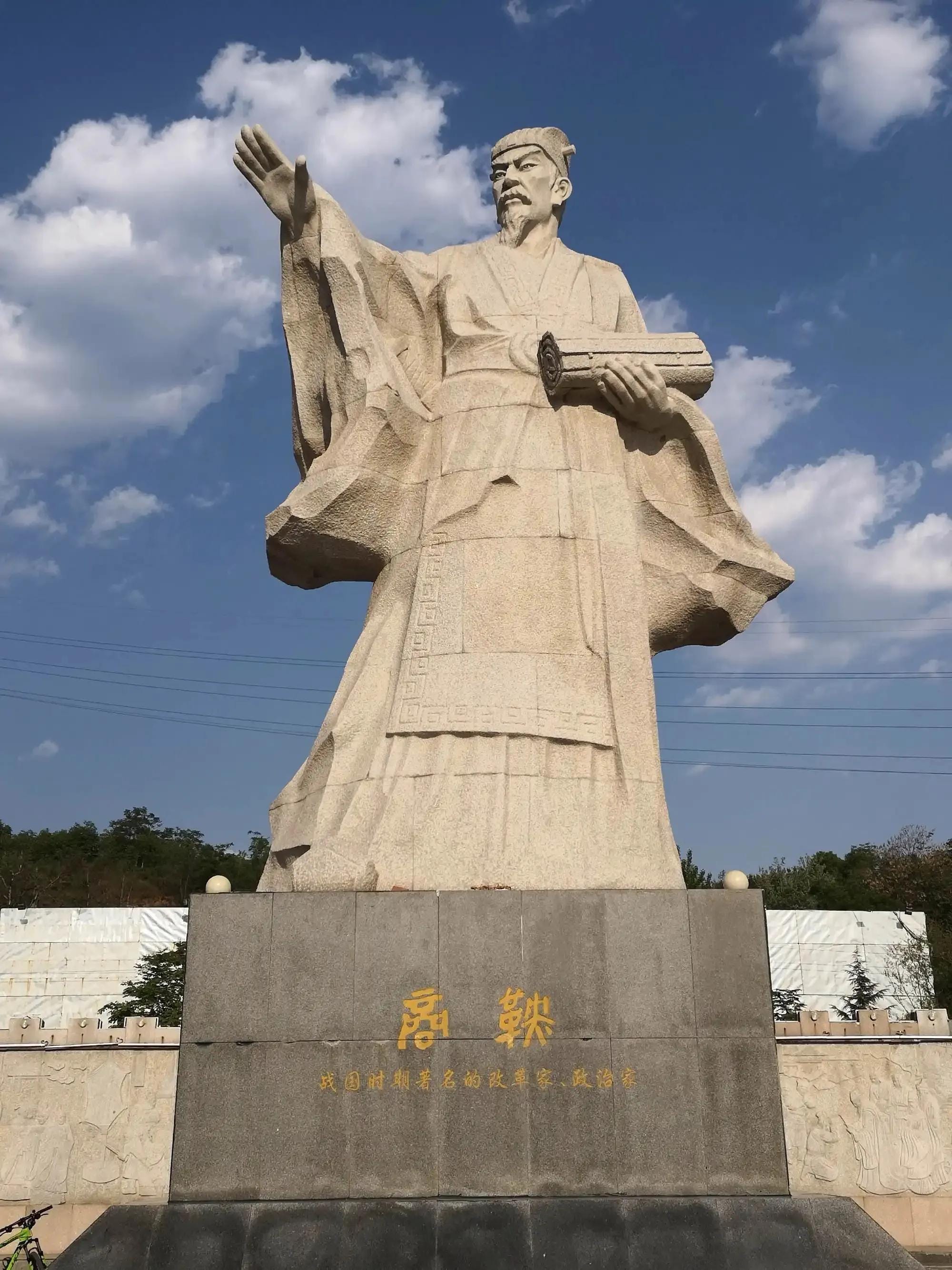
The most famous of the Legalist ministers was Shang Yang, chief adviser to the ruler of that same state of Qin, who lived a century before the construction of that canal.
He not only carried out all the standard Legalist reforms, but also forbade the population from engaging in virtually anything that, in his view, brought no benefit to the state: music, philosophy, trade (Legalists disliked merchants, since they were constantly on the move and therefore difficult to tax), and even simple idleness.
The laws he introduced regulated practically every aspect of life.
The punishments for violating them were severe — and the same for everyone.
Once, when the crown prince, still a teenager, threw embers from a hearth into the street — an offense that Shang Yang’s legal code treated harshly, since it could cause a fire.
The prince himself, being both a minor and heir to the throne, was spared direct punishment and instead banished from the palace. But one of his tutors had the word criminal tattooed on his face, while the other — himself a prince and the elder brother of Qin’s ruler — had his nose cut off.
Neither the young prince nor the mutilated noble forgot this.
When the ruler died, the noseless prince immediately accused Shang Yang of treason, and the former crown prince, now king, happily found him guilty and sentenced him to the most terrible form of execution: being torn apart by chariots.
Shang Yang tried to flee, but the owner of an inn turned him in. Under a law introduced by Shang Yang himself, innkeepers were required to register all guests by their documents (as in the EU today), and violating that rule carried the death penalty (not in the EU yet).
Shang Yang was captured and torn to pieces, each limb tied to one of five chariots.
But his work lived on.
Qin’s new ruler rid himself of a hated enemy, yet made no attempt to repeal his reforms.
Gradually, Qin transformed into a powerful, fully militarized totalitarian state and conquered its rivals one by one. A little more than a century after Shang Yang’s death, in 221 BC, one of Qin’s later rulers, Ying Zheng, destroyed the last remaining rival and united all of what was then China, becoming its first emperor. Before him, no such title had existed in China.
But the Qin Empire survived for only fourteen years, outliving the emperor himself by just four.
In 209 BC, a year after his death, a prosperous peasant named Liu Bang was ordered to escort a convoy of prisoners to work on the construction of Ying Zheng’s mausoleum.
On the way, several prisoners escaped.
Under Qin law, anyone responsible for such an escape was subject to execution. Liu Bang had little reason to continue the journey only to lose his head upon arrival.
Instead, he armed the remaining prisoners and formed them into a fighting force, with which he launched a rebellion against the empire.
The people had long been groaning under unbearable taxes and inhuman laws, so this became the spark that set the whole country ablaze. Within three years, Liu Bang, at the head of an army that had grown a thousandfold, entered the capital and proclaimed himself the new emperor.
Thus began the Han Empire.
8. Changing Tracks
At first, it seemed that China had returned to feudalism.
Following Zhou tradition, Liu Bang granted half the empire’s lands to his companions-in-arms. Later he changed his mind, killed them all, and transferred their territories to his sons and brothers, making them hereditary princes.
As under the Zhou, they were expected to defend their lands against barbarians, supply troops to the emperor in time of war, offer him tribute, and acknowledge his supremacy. But in most respects they were largely independent: they maintained their own armies, collected taxes into their own treasuries, and even minted their own coins.
In place of Legalism, the official doctrine of the new dynasty became Huang-Lao: a form of Daoism adapted to imperial needs, which proclaimed that the ruler should practice wu wei — non-action.
This non-action led nowhere good.
Under the Zhou, the feudal lords had waited five hundred years before ceasing to obey the king. Under the Han, it took only fifty
But this time the story ended differently.
Seeing that his vassals were brazenly ignoring him, the sixth emperor of the Han dynasty, Emperor Jing, decided to suspend non-action for a while and weaken the insolent princes by stripping them of part of their lands on pretexts of questionable legality.
He knew this might provoke open rebellion, but reasoned that it would be better for them to rebel now than later, when they had grown even stronger.
That is exactly what happened.
But because the hereditary princes had little time to prepare, they failed badly. The emperor crushed the rebellion in three months and dissolved the rebel principalities.
As for the princes who had remained loyal, he left them their land but stripped them of their privileges, forbidding them to maintain armies, collect taxes, or mint coins.
The reform was completed by his son, Emperor Wu, who ordered the remaining feudal lords to divide their lands among all their sons, instead of leaving them to a single heir.
And feudal lords tended to have many sons. Within a couple of generations, what had once been vast domains were reduced to scraps.
Thus feudalism finally came to an end in China.
All subsequent dynasties, having learned from the mistakes of the Zhou and Han rulers, never again allowed relatives or allies to establish semi-independent duchies and principalities.
Why did China not follow the same path as Europe? Why did feudalism not evolve there first into a limited, aristocratic form of parliamentary government, and eventually into full democracy?
Perhaps it was simply a matter of chance.
In Europe, the balance of power was roughly even: for a long time, barons could not decisively defeat kings, and kings could not fully subdue barons. As a result, they were forced to negotiate.
In China, by contrast, during the Zhou era the dukes and marquises easily defeated the king, while in the Han era the emperor quickly crushed the dukes and marquises. Parliament — an institution for reconciling their interests — proved unnecessary in both cases.
But perhaps the explanation lies elsewhere.
To invent democracy (as opposed to importing a finished product, as Japan did in the late nineteenth century), feudalism alone may not be enough.
Additional conditions may be required: an independent Church acting as a supreme arbiter, the tribal traditions of the ancient Germans, who settled important questions in the thing, and the lingering memory of the Roman Republic and Roman law.
Without all of that, Europe too might never have developed parliaments.
Or perhaps it still would have. We cannot know.
Be that as it may, by the middle of the second century BC — precisely at the height of the Roman Republic — China had become what might be called a standard eastern despotism, with the emperor ruling the provinces through officials entirely dependent on him.
Though not quite a standard one.
Emperor Wu made a cynical masterstroke. He simultaneously condemned Legalism, officially banning its hated by the people adherents from holding government office, and… quietly restored the old Legalist practices that had largely disappeared under his predecessors (his father, Emperor Jing, had been a great enthusiast of Daoism).
For the first time, China’s official ideology became Confucianism. It remained so until the beginning of the twentieth century, and in significant ways remains so even today: Marxism has long since become little more than a façade, and it is no accident that the PRC’s cultural and educational centers abroad are called Confucius Institutes.
But this was no longer quite the Confucianism preached by Confucius himself, or by his successor Mencius. It was a hybrid of Confucianism, Daoism, and the now-banned Legalism, whose core ideas China’s rulers never wished to abandon, since they were so useful in governing the state.
From Confucianism, the new ideology retained its essential concepts: virtue, duty, and respect for hierarchy.
From Daoism, it borrowed the principle of wu wei — non-action. According to the new doctrine, the ideal ruler was not one who governed the state personally in a hands-on manner, but one who created the conditions for prosperity by appointing virtuous ministers and promulgating virtuous laws.
From Legalism, it retained rule through those laws.
Under the Han, the laws became somewhat less severe and, according to the new state ideology, were now supposed to serve not only the convenience of the emperor, as the Legalists had proclaimed, but also the welfare of ordinary people, protecting them from the arbitrariness of officials.
The emperor could change these laws however he wished, but he could not rule through sheer whim.
He could not punish someone for a crime that did not exist: If the emperor wished to punish someone for an act not yet forbidden, he first had to forbid it and send proclamations throughout the empire announcing the ban.
And the law had no retroactive force — only those who violated it after its promulgation could be punished.
This was not a rule of law — the population had no rights, and the very idea would likely have struck Chinese philosophers as absurd or even offensive.
But it was rule by law.
Thus China acquired one of the three institutions that would shape the whole of its later history.
This institution was never unique.
In Western Europe, for much of history, there existed a rule-of-law state — or at least something resembling one.
And in Byzantium there was a system strikingly similar to the Chinese one, in which the emperor could issue any laws he wished, but those laws took effect only from the moment of their proclamation.
But beyond Europe and China, nothing quite like this existed.
There, rulers — and not only rulers, but influential officials and local authorities as well — could do more or less whatever they pleased.
In Muslim countries, to be sure, they were constrained by Sharia, but Sharia does not regulate everything, and beyond its limits there remained considerable room for arbitrary power.
As for the final formation of the other two key institutions that would define Chinese society — one entirely unique, the other unique for its time — the Chinese would have to wait another thousand years.
The second part, The Invention of Capitalism, is here.