

Lame Eagle
How America Unlearned to Win

I.
It’s quite likely that many years from now American history textbooks will describe June 18, 2026 as a day of national dishonor. On that day, a Thursday, Donald Trump signed the 14-point Memorandum of Understanding with Iran that looked very much like capitulation. In this Memorandum Iran didn’t commit to anything substantial except to open the Strait of Hormuz for only 60 days and to discuss its nuclear program. The U.S. committed to immediately and permanently stop all hostile actions against Iran, including the one in Lebanon (meaning Israeli ones), to lift all the sanctions imposed on Iran over the last decades, including sanctions imposed by international bodies, and to pay Iran a huge amount of money.
Never before did the United States sign such a humiliating agreement. Trump and his claque are claiming that it’s not final and can be taken back. Maybe, though today it doesn’t seem likely. But even in such a case, it won’t undo the uncomfortable fact: the Memorandum is signed and it’s by the President of the United States. The President of the United States agreed to terms that—and there’s no way around it—look very much like unconditional surrender. To make it look even worse, he did it in the most symbolic place possible: Versailles.
The most stunning thing is that America surrendered without losing the war. On the contrary, it was winning. Mere weeks before signing the capitulation, the President demanded unconditional capitulation from Iran. Mere days before signing it, he threatened Iran with devastating military strikes. Those strikes hadn’t been bravado; they were possible, but they never came. Instead, American leadership imploded.
It’s very tempting to attribute it to Trump’s personal qualities. And that’s what most commentators are currently doing. Trump’s qualities certainly played a huge role in the specific way this historical humiliation had been achieved. But there’s more to this than his personality. The Iran disaster has been in the making not for months, or even years, but for decades. It is the culmination of a series of failures that began more than three-quarters of a century ago.
II.
On June 25, 1950, less than five years after the end of WWII, the North Korean army invaded South Korea, starting the first war in which the recent wartime allies, the USSR and the USA, fought on different sides.
North Korea had been preparing for this war for a year, its military armed and trained by the Soviet Union. South Korea and the U.S. hadn’t been prepared for the war at all. The then-American president, Harry Truman, was expecting a stand-off with the Soviets, but in Europe, not Asia. South Korean defenses were overwhelmed, its capital, Seoul, captured in three days. By the end of August all that was left of the state was a small patch of land around its biggest port at the very southwest of the peninsula, Busan.
The Soviet Union was well-prepared militarily, but it badly miscalculated diplomatically. It boycotted the recently created UN Security Council because instead of the Communist government, China at the time was represented in the Security Council by the Kuomintang, which had just a year earlier decisively lost the civil war and evacuated to Taiwan.
With the Soviet Union absent, and China represented by anti-communists, the Security Council almost unanimously (only Yugoslavia abstained) supported a resolution condemning the aggression. Two days later the Security Council adopted another resolution, calling for the deployment of international troops for South Korea’s defense. This time Yugoslavia voted against, but it changed nothing.
The coalition included several states, from the United Kingdom and France to Thailand and Ethiopia, but the bulk of the troops, 90%, were Americans. But it took a while to send them.
Due to Truman’s bet on nuclear containment, the conventional American forces had been heavily scaled down after 1945. After Truman ordered a naval blockade of North Korea, he found out that the Navy didn’t have enough ships to implement it. To send tanks to the Korean peninsula the Army had to literally take them from their display pedestals around Fort Knox.
Busan, the last South Korean and American forces’ foothold on the peninsula, withstood constant attacks, largely because American air raids destroyed surrounding roads and bridges and disrupted North Korean logistics. By late August, the American military finally managed to mobilize forces and they started to arrive en masse.
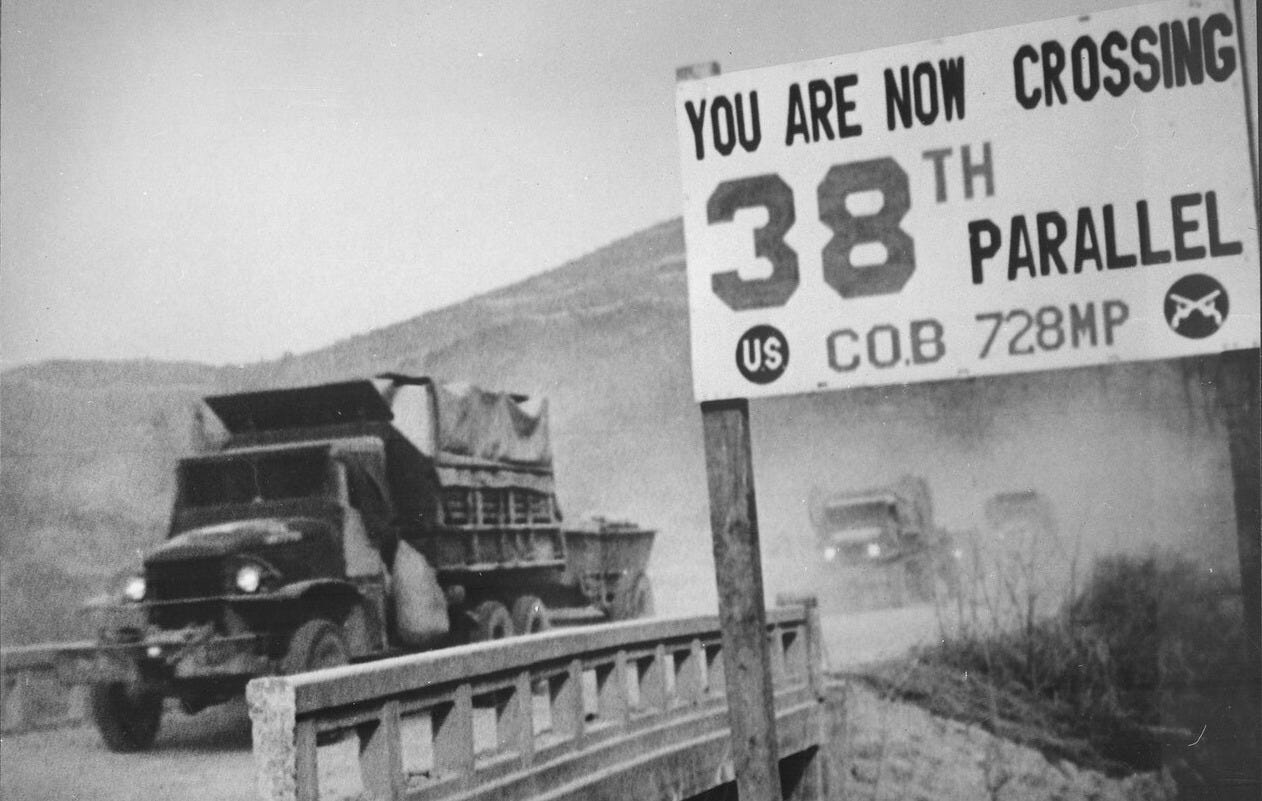
On September 15, the U.S. launched a surprise landing at the other end of the peninsula, at Incheon, next to Seoul. The next day American troops started a counter-attack at the Busan perimeter. North Korean troops imploded almost immediately: the Busan perimeter was breached after two days, Incheon fell in four. On September 25 American, South Korean and allied troops recaptured Seoul. By the end of the month the entire pre-war territory of South Korea south of the 38th parallel had been liberated.
It could be called a swift and decisive victory, but the commander of the allied forces, Douglas MacArthur, decided to press further and liberate all of Korea from the Communists—a noble and worthy purpose. Even earlier the South Korean president Syngman Rhee announced that ROK troops wouldn’t stop at the 38th parallel even if the Americans didn’t join them.
At first, the offensive was a great success.
On October 11 ROK forces themselves, without direct American help, captured the major North Korean industrial center and port of Wonsan. On October 17 they took the third largest North Korean city, Hungnam.
On October 19, after only two days of fighting, the Americans, Koreans and British divisions took the North Korean capital, Pyongyang.
The same day, eager to prevent the total collapse of North Korea by any means possible, Mao Zedong ordered the PLA to cross the Korean border.
III.
The first and so far only war between the U.S. and China had begun.
The allied troops meanwhile continued to push forward. By October 24 they captured most of North Korea, except for its northernmost regions. The first encounter happened on October 25, when Chinese troops encircled Korean and American troops near Unsan. The allied forces eventually managed to break out of the encirclement, losing hundreds of men and almost all their heavy equipment, but the battle was a clear Chinese victory.
It was only the first one. Soon the Chinese won at Ch'ongch'on River, then at Lake Changjin, and by Christmas the Americans, South Koreans and allies were forced to abandon entire North Korea. The front moved back to where the war had started: the 38th parallel. On January 7 the Chinese recaptured Seoul and moved further south.
But by late January the Americans recovered from their defeats, stabilized the frontline and in March pushed back and liberated Seoul once again.
Before the Americans decided to cross the 38th parallel, the war was a clear win for them. But in 1953 it was anything but victory. The U.S. troops had been beaten back by the Chinese, lost several major battles and had not achieved their goal of liberating the peninsula from the Communists. Yes, the Chinese lost many more people, about 200 thousand dead and missing, against 36.5 thousand Americans, but for the Chinese leadership it wasn’t a problem: people were just another resource to spend.
The Chinese had the same problem: while at the start of the war their main objective was to save the North Korean regime and prevent the constant presence of American troops at China’s border, after taking Seoul Mao was so fired up that he started to demand of his generals “annihilate all enemies and liberate all Korea".
By April 1951 the war was mostly a stalemate. The next two years saw constant back and forth: none of the sides could move deep inside the other’s territory, until in July 1953 North and South Koreans signed an armistice, largely returning the situation to the status quo ante bellum, with almost three million lives lost.
The Korean War became the first major war after 1812 that the U.S. couldn’t win. The first of many.
IV.
After that America could not decisively win a single major war it started.
The claim might seem strange: every reader probably can name a war or two that America won. We’ll come to that, but first we should define what winning is.
For most countries it would mean repelling a foreign aggression like the one that Russia launched against Ukraine and recovering their territory, or at least surviving if the enemy plans to annex them. Finland in 1940 arguably won though it had to cede a big chunk of its territory to the USSR, because it managed to defend its independence: the Soviets originally planned to occupy the entire country and even created and officially recognized a puppet Communist Finnish government.
For an aggressor it’s the opposite: a victory is a successful annexation of part or the entire territory of another state.
But America is not a small country under a constant threat from a larger aggressive neighbor. It’s the biggest global superpower. Nobody has tried to invade it in the last two centuries.
Neither is it an aggressor in the traditional sense of the word: it hasn’t tried to annex any land since 1898.
Instead, the U.S. fights for its sphere of influence. If it enters a war, it’s either to keep a hostile country from infringement on its sphere of influence or to extend this sphere. And, by this definition, except for the Cold War, which was a war in name only, since 1945 America doesn’t have much to show.
After the Korean War the U.S. participated in many small military operations and regime changes but only in five major wars with remotely serious opponents: in Vietnam, Iraq, Yugoslavia, Afghanistan and now Iran.
Nobody except total loggerheads would argue that Vietnam and Afghanistan had been major defeats. The Iran war is not technically lost yet: though Trump has already signed the capitulation, it plausibly can reignite. But the other two, Iraq and Yugoslavia, are often wrongly considered victories: the Iraqi one even as two separate victories in a row.
It’s wrong.
V.
There weren’t two Iraq wars, there was only one, which lasted from 1991 until 2013 and only partially achieved its main goal.
After Saddam occupied Kuwait, its liberation was only the minimum objective. The George Bush administration wished to solve the problem at its root, i.e. to remove the hostile Saddam Hussein regime that had destabilized a key world region for years. But, as George Bush himself later admitted in his article in Time, the idea of marching on Baghdad had been rejected because of fears that such an attempt would destabilise the international coalition. Instead, the Americans hoped—as they did this year in Iran—that Saddam’s military humiliation would start a popular anti-regime uprising. As in the Iranian war, the uprising had never materialized.
With Saddam staying in power the war hadn’t been truly over, and both the Bush administration and the following Clinton administration understood it quite well. That’s why though the Gulf War had been over in name by March 1991, it hadn’t been over in practice. Shortly after the official end of the war the U.S. introduced two no-fly zones over North and South Iraq to protect Kurds and Shiites respectively, but also to weaken the regime. And not only zones: roughly every two years Americans bombed Iraqi military installations across the country and, occasionally, government buildings in Baghdad and Saddam Hussein's palaces, until on March 20, 2003 George Bush Jr. decided to finish the task unfinished by his father and put soldiers’ boots on the ground.
Baghdad fell on April 9, the entire country was captured by April 30, and Saddam was found and arrested on December 13, 2003. But even that unexpectedly hadn’t ended the war. The fall of the regime created a power vacuum that American forces couldn’t effectively fill. This vacuum drew in rebel forces from various, mostly religious, factions and sects. In 2011 Americans pretended that they had stabilized the regime and withdrew their troops—only to return two years later after most of Iraq had been captured by one of the insurgent forces: ISIS.
The troops had to stay for eight more years and were withdrawn again in 2021. A small contingent of several thousand soldiers stayed, but in 2025, on demand of the Iraqi government, it was cut to 250–300 men. Today, 35 years after the war began, Iraq is far from a staunch American ally. The mostly Shia country is ruled by a mostly Shia government maintaining close political and economic ties with Shia Iran. The country hosts the so-called Popular Mobilization Forces—a 230,000-strong armed militia trained and armed by the IRGC and answering to the Iranian supreme leader. For comparison, the Iraqi Armed Forces are only 190,000-strong.
Removing an anti-American dictator to replace him with a regime heavily influenced by the worst American enemy in the region, if not the entire world, could hardly be called a victory. At best, it is a draw.
Yugoslavia in 1999 was a similar, though less daunting case. The immediate and minimal goal was to stop the ethnic cleansing of Kosovo Albanians, and it was successfully achieved. The maximum goal, to remove Milošević from power, was achieved too: unlike in Iraq, the military defeat indeed undermined his legitimacy and in about a year his regime fell under pressure from mass protests.
But again, Yugoslavia didn’t become an American ally. Every Yugoslav and Serbian government in the last 20 years has been pro-Russian and anti-American, though not as aggressively anti-American as Milošević's was. It clearly states that it’s not going to join NATO, and though it’s trying to join the EU, most likely if it succeeds, it’ll be a Russian and Chinese Trojan horse in the European Union.
Once again, it looks not so much like a decisive victory as a buried problem waiting to rise again.
VI.
Of the six major wars the U.S. fought after 1945, two, the Vietnam and the Afghan ones, were clear, undisputable losses and three more ended in draws. The current one, in Iran, is on the way to becoming the worst loss of them all and has already led to the biggest American humiliation in history. To add insult to injury, all those wars, except for the second half of the Korean War, America fought against much smaller and weaker adversaries.
What a huge contrast to the earlier superpowers. Rome between the 3rd century BC and the 2nd century AD won every single war except the wars against its rival superpower, the Parthian Empire. The British Empire in the 18th and 19th centuries was somewhat less glorious and saw some defeats and draws, but never several decades in a row without a victory.
Why? Why can't the most powerful state in the world for the last 76 years win a war, even though in every one of them it has enjoyed a clear military advantage?
It’d be easy to chalk that up to the changed rules of war: in the 20th and 21st centuries Americans can’t fight as ruthlessly and mercilessly as the Romans and the British did earlier.
But it would be a lie. In the Korean and Vietnam wars some U.S. actions, particularly carpet bombings of North Korean and North Vietnamese cities to destroy the enemies’ industrial base and demoralize their population, could easily be qualified as crimes against humanity.
In Yugoslavia NATO did what Putin is doing now in Ukraine: it deliberately bombed energy installations to cut electricity supply to the civilian Serbian population.
During the early phases of the Afghan and Iraq wars Americans unlawfully detained and tortured "illegal enemy combatants" in Guantanamo and Abu Ghraib, violating the Geneva Convention, as the U.S. Supreme Court admitted in 2006.
None of this helped.
On the contrary, when it appeared in the news, it helped make the wars unpopular and create public pressure to end them before they could be won.
Maybe this—the mass media—is the real reason the U.S. lost the ability to win wars?
But mass media already existed in the late 19th and early 20th centuries; they already reported military atrocities, like the concentration camps the British created during the Boer War, and those reports already caused mass outrage at home.
In those times, though, it helped stop the atrocities, not stop the war itself before it had been won.
That’s another seemingly plausible but questionable explanation: democracy and public opinion. In autocracies rulers can send their subjects to die year after year after year, but in democracies people don’t want to die fighting in foreign countries, and when the corpses start to pile up—or even when prices go up—politicians who want to be reelected prefer to call back the troops.
That’s certainly true: all the wars American presidents couldn’t win, they stopped for political reasons. On the battlefield, in all the aforementioned cases, American troops weren’t losing; it was American politicians who decided to fly the white flag.
But here’s a twist: democracy didn’t work this way before the mid-20th century. Both America and Britain won most of their wars while being quite democratic, and most voters seemingly didn’t care that their country was fighting one war after another.
Even more telling, in most Ancient Greek poleis, the Roman Republic and the early Swiss Confederation, the decision to go to war or to make peace had to be approved by all citizens in a public assembly. And the citizens voted for war again and again, seemingly not minding it at all. Peace without a victory was far less popular.
VII.
What has changed?
Most likely, women’s suffrage. It was introduced in 1920 and soon afterward America stopped winning.
Though probably not for the reason you may think.
What’s stunning about Ancient Greece, the Roman Republic and the early Swiss Confederacy, all of which were quite belligerent, is that the decision to go to war was so often and easily approved by exactly the same people who could die in it: in all those countries the right to vote belonged to men capable of bearing arms and actually bearing them after they voted for a war. In the Roman Republic the public assembly itself was called the Comitia Centuriata and, until at least the early third century BC, was structured by centurias, Roman military units.
In the 19th and early 20th centuries, men in America and most European countries couldn't vote for or against every single war, but it was still them, those who fought wars, who elected the leaders who started them, and seemingly they minded wars less often than voters do now.
You go to war, you decide if it’s worth starting or ending it.
After women’s suffrage this link was broken. Not because women are inherently more peaceful than men and want to end any war, but because they don’t fight.
After 1920, the political system changed, but the army did not. Both men and women could now vote, but only men could fight. In the late 20th century this formally changed: the army slowly opened to women and in 2015 they finally got the right to serve in any military role without limitations, provided that they pass all the tests.
But even today they account for less than 20% of total military personnel and less than 5% of the personnel involved in actual combat.
During the Afghan and Iraqi wars the share was much lower, while during the Vietnam and Korean wars it was close to zero.
When push came to shove, for men it was “Should I go fight and maybe die?” The answer may be Yes or No. But for women it was “Should my husband or son go die?” To this question, the answer is always No (except when the state pays you a lump sum for your fallen husband, as they now do in Russia—in this case, it depends).
This asymmetry creates a skewed set of incentives. The American government learns, but it learns the wrong things. In recent decades it has learned to start wars that can be easily won on the ground instead of wars that truly have to be fought. “Boots on the ground,” which are indispensable for victory, became a taboo.
And, of course, the government always miscalculates, and a war that was supposed to be a short walk in the park lingers on for years or decades before being dishonorably cancelled because of another miscalculation.
Governments always miscalculate. People always miscalculate. But when the incentives hadn’t been skewed, those miscalculations didn’t stop America from winning the wars that objectively had to be won to prevent further, graver, problems.
Today those hard but necessary wars are either fought by proxies or substituted by sanctions. Neither of these approaches really works, creating further problems instead of solutions.
VIII.
Can anything be done about this quagmire?
The share of women in the American army constantly and quickly increases, so maybe the problem will soon be solved on its own?
Hardly. There’s another asymmetry created by the Vietnam War. The war ended conscription and the army became professional. It severed the link between the people who vote and the people who fight even further. With a relatively small professional army, even if the share of women reaches 50%, it won’t bridge this gap.
The best solution would be if the army itself decided whether it needs to fight and when it needs to stop, as in Ancient Greece and Rome. But in the current political system it is obviously impossible.
The real solution that is possible, at least in theory, would be deeply unpopular and hardly feasible in practice: to introduce universal conscription. Not the universal male conscription of the past, but a truly universal conscription, like in Israel. Not to replace the professional army but to supplement it. The positions that demand extensive training and highly specialized skills, like special operations, should remain professional. But the bulk of the army should consist of ordinary people of all genders and ages, capable of bearing arms.
If the fate of the Iranian war had been decided by those who had to fight in it, it would probably never have started. But if it did, there’s no chance in hell they would agree to the conditions signed by Trump, unless Iranian troops stood on the banks of the Potomac.
For a long time I was a convinced supporter of the professional army and a passionate opponent of conscription. But in the last few years my position changed. Now I believe that Robert Heinlein was right all along and that a real democracy should work on the principle, “If you don’t serve, you don’t vote.”
Not because of valor, virtue and other lofty matters, but because sometimes states have to fight wars, and only the people who have skin in the game should decide if this particular war is worth starting and worth continuing. Their own skin, that is, not someone else’s.
Unfortunately, introducing universal conscription today would be political suicide.
That means that most likely the U.S. will keep starting unnecessary “easy” wars and dishonorably end them at the first sight of trouble, and will avoid entering necessary wars that require real effort and patience. With every lost war America will lose respect and increasingly be perceived as a paper tiger. Until one day, because of this perception of weakness, America will find itself in a war that it didn’t want to fight, just as it did in December 1941.
In the current political climate it seems all but inescapable.
Could drones and ai drones be gamechanger in this situation? And reason for rejecting democracy at all? No need for mass armies, no need for voters. We see already, how drones compensate lack of infantry in Ukraine.
> What has changed?
> Most likely, women’s suffrage.
That's an interesting angle, though unexpected. Quick check for gender bias in US elections: men are in favor of the GOP by 10-12 percentage points, women vote for Democratic candidates by 6-8 pp. These numbers are roughly the same for both presidential and congressional elections, as well as for state-level initiatives. This is significant, but not definitive. However, the gap widens for young voters: 25 pps more women vote for Dems vs. 16 pps more men vote for Republicans.
Also, do you think that Israel is more aggressive military-wise because they have universal conscription, including women?